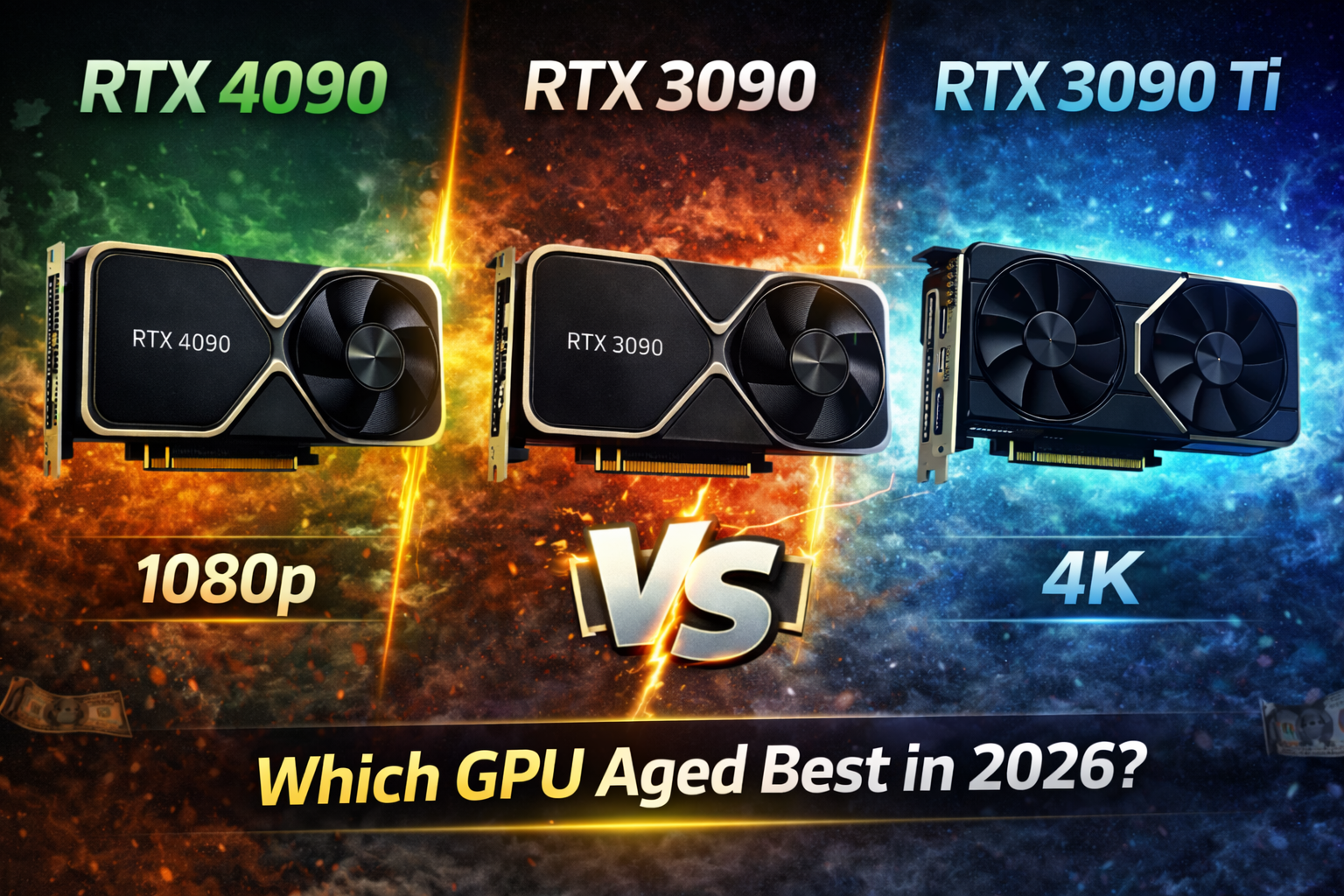
This Article Is For
- 4K gamers deciding whether Ampere still holds up
- RTX 3090 / 3090 Ti owners considering a late-generation upgrade
- Buyers evaluating long-term GPU value beyond launch benchmarks
How NVIDIA’s Flagship Actually Aged Across Resolutions, Power, and Value
When the RTX 4090 launched, it wasn’t just faster than the RTX 3090 and 3090 Ti — it was dramatically faster. Early benchmarks showed massive gains at 4K, modest gains at lower resolutions, and a level of performance that made previous-generation flagships look suddenly outdated.
But hardware doesn’t exist in a vacuum.
Three years later, the more interesting question isn’t how fast the RTX 4090 was, but how well that performance has aged — and whether the jump from Ampere to Ada still makes sense depending on how you actually play today.
RTX 4090 vs RTX 3090 Architecture & Key Differences
➤ RTX 3090 vs. RTX 4090: Deep Dive Into NVIDIA’s Powerhouses
This article explains the architectural improvements and general performance benefits of the RTX 4090 over the 3090.
This article revisits large-scale benchmark data from a 25-game comparison and re-interprets it through a 2026 lens: modern game engines, real resolution usage, power efficiency, and value over time.
Test Foundation & Methodology (Context)
The core performance data discussed here is based on a comprehensive 25-game benchmark suite comparing the RTX 4090, RTX 3090, and RTX 3090 Ti across 1080p, 1440p, and 4K, using a high-end CPU platform to minimize bottlenecks RTX 4090 vs 3090 & 3090 Ti, 25 ….
Key testing conditions included:
- Ryzen 9 7950X system
- DDR5-6000 memory
- Windows 11 (fully updated)
- Resizable BAR enabled
- Consistent graphics presets across titles
Rather than re-listing every game result, this article focuses on patterns, scaling behavior, and what those results actually mean in 2026.
Resolution Scaling: Where the RTX 4090 Truly Separates Itself
1080p: Diminishing Returns at the Top
At 1080p, the RTX 4090 never truly made sense — and that hasn’t changed.
Across the 25-game average:
- RTX 4090 was ~18–22% faster than RTX 3090 / 3090 Ti
- Many CPU-heavy titles showed single-digit gains
- In several esports and simulation games, performance was effectively identical
- Benchmarked performance differences between 4090 and 3090 series
➤ RTX 4090 vs 3090 / 3090 Ti Benchmarks Summary
This comparison notes that the RTX 4090 is significantly faster (~75% vs 3090 and ~60% vs 3090 Ti) in various benchmarks.
2026 reality:
If you are gaming at 1080p, even with a high-refresh monitor, the RTX 4090 remains wildly underutilized. Modern CPUs, not GPUs, are still the limiting factor here.
1440p: Transitional Territory
At 1440p, the RTX 4090 begins to stretch its legs — but inconsistently.
Average uplift:
- ~30–39% over RTX 3090
- ~32% over RTX 3090 Ti
However, scaling still heavily depended on the title:
- GPU-bound games benefited substantially
- CPU-bound games saw minimal improvement
2026 reality:
1440p is where the RTX 4090 starts to make sense only if you:
- Max settings
- Use heavy ray tracing
- Target very high refresh rates
Otherwise, Ampere still holds surprisingly well.
4K: This Is Where Ada Was Built to Dominate
At 4K, the RTX 4090’s design intent becomes undeniable.
Across the 25-game average:
- ~63% faster than RTX 3090
- ~52% faster than RTX 3090 Ti
Some titles showed:
- 70–80% gains
- In extreme cases (e.g., F1, Apex), even higher deltas
Even more impressive:
- 4090’s 1% lows at 4K often exceeded the average FPS of the 3090
2026 reality:
If you game at 4K, the RTX 4090 has aged exceptionally well. The gap did not shrink — it became more relevant as newer titles pushed GPUs harder.
CPU-Heavy Games: A Reality Check
One of the most important takeaways from the original data — and one that matters even more now — is that not all games reward GPU upgrades equally.
Titles like:
- Microsoft Flight Simulator
- CSGO / CS2
- Strategy and simulation games
showed:
- Near-identical performance at 1080p and 1440p
- Only modest gains at 4K
2026 reality:
GPU power does not replace CPU limitations. Even the fastest GPU in the world cannot brute-force poor engine scaling.
Power, Efficiency, and the Long Game
On paper, the RTX 4090’s 450W power rating looks intimidating.
In practice, it tells a more nuanced story.
Despite similar peak power limits:
- RTX 4090 delivered 50%+ performance gains
- While consuming only marginally more power than RTX 3090 Ti in many scenarios
This resulted in:
- Significantly better performance per watt
- Lower relative energy cost per frame
- Ada Lovelace Architecture Details
➤ Ada Lovelace GPU Architecture Explained (Wikipedia)
This page explains how the Ada Lovelace architecture (used in the RTX 4090) improves performance while managing power, with insights into clock design and GPU reception.
2026 reality:
Efficiency isn’t about low wattage — it’s about output per watt.
The RTX 4090 remains one of NVIDIA’s most efficient high-end GPUs ever produced in real workloads.
Ray Tracing: A Generational Leap That Aged Well
Raw raster performance was only part of the story.
In heavy ray-traced workloads (e.g., Cyberpunk 2077 RT Ultra at 4K):
- RTX 4090 was ~70% faster than RTX 3090 Ti
- Over 90% faster than RTX 3090 in some cases
As ray tracing adoption increased post-2023, this advantage became more relevant, not less.
RTX 4090 ray tracing and upscaling advantages
➤ RTX 4090 Review & Ray Tracing Capabilities at 4K
TechSpot’s review shows significant performance improvements for the 4090 over the 3090 Ti, including ray tracing benchmarks that support modern gaming performance claims.
2026 reality:
Ada’s RT improvements were not theoretical. They translated directly into real, playable performance in modern titles.
DLSS 3 and Frame Generation: The Wild Card
At launch, DLSS 3 was controversial:
- Synthetic gains
- Latency concerns
- Limited game support
Three years later, the landscape changed.
- DLSS 3 adoption expanded
- Frame generation became a practical performance multiplier, especially at 4K
- Ampere cards remained locked to DLSS 2
2026 reality:
DLSS 3 is not a replacement for raw power — but combined with Ada’s baseline performance, it extended the RTX 4090’s usable lifespan far beyond Ampere.
Cost per Frame: Value Depends on Resolution
From a pure cost-per-frame perspective:
- RTX 3090 often looked better at 1080p and 1440p
- RTX 4090 became competitive — and sometimes superior — at 4K
Key insight:
Value is resolution-dependent.
Paying more only makes sense when:
- The performance scales
- The GPU is actually utilized
Final Verdict: How the RTX 4090 Aged
Three years later, the story is clear:
The RTX 4090:
- Aged exceptionally well at 4K
- Maintained leadership in ray tracing
- Delivered class-leading performance per watt
- Benefited from newer features that aged better than expected
The RTX 3090 / 3090 Ti:
- Still competent at 1440p
- Surprisingly resilient in CPU-bound games
- Increasingly limited in modern RT-heavy titles
The Real Conclusion
The RTX 4090 was never meant to replace Ampere at every resolution — and it didn’t need to.
It was built for:
- 4K
- Heavy workloads
- Long-term relevance
| Resolution | RTX 4090 vs RTX 3090 | RTX 4090 vs RTX 3090 Ti | Verdict |
|---|---|---|---|
| 1080p | +18–22% | +16–20% | Not worth it |
| 1440p | +30–39% | ~32% | Situational |
| 4K | ~63% | ~52% | Massive win |
In that role, it succeeded — and in 2026, it remains one of the clearest examples of a generational leap that actually held up over time.
Leave a Reply